Establishing the Atlantic-Arctic Distributed Biological Observatory (A-DBO)
After the end of the Arctic PASSION project a new website has been set up here:
A-DBO
The website you are now visiting will thus no longer be updated.
Information about the upcoming 2026 A-DBO autumn meeting in Sopot, Poland, 23-25 November can be found at A-DBO autumn meeting 2026
BACKGROUND
🏁 The Arctic PASSION project now has reached its end and there have been some changes ahead in the organizational structure (Exec team, Steering Group, etc). But we continue building the network with the capabilities and enthusiasm we have!
During 2022–2025, Arctic PASSION provides the means for increased coordination capabilities to establish the Atlantic-Arctic Distributed Biological Observatory (A-DBO) network and the common practices for sampling, analysis and data sharing. The establishment process is open to scientists and institutions with interest to collaborate in this region, as well as to end-users who will benefit from results from the A-DBO. This webpage serves as our main hub of information during the pilot implementation phase. From here you will be able to find contact info, access common documents, and get the latest information about our events. The opportunities for getting involved are listed in 'Upcoming Events' below.
The A-DBO is envisioned as a comprehensive marine observing network for climate and environment in the Atlantic sector of the Arctic Ocean – one of the key gateway areas of the Arctic, currently experiencing rapid environmental, climate and ecosystem changes. Together with the pioneering observatory in the Pacific sector of the Arctic Ocean (DBO), and developing DBOs in Davis Strait/Baffin Bay and the Siberian seas, the Atlantic DBO contributes to the pan-Arctic network of DBOs (PAN-DBO).

The current four Distributed Biological Observatories overlaid on a bathymetric map of the Arctic Ocean.
Coloured dots indicate key sites (standard stations) while bounding boxes outline hot spots (focal areas) of each DBO.
The fundamental motivation for the DBO sampling concept is to work across disciplines in dedicated geographical areas toward better integrated and available observations. The DBOs are shaped to:
- Cover key ocean phenomena and processes under rapid change
- Bring together all disciplines needed to understand the marine ecosystem functioning
- Increase the data coverage within the focal areas
- Utilize common, harmonized procedures for data sampling and sharing
- Facilitate both dedicated (long-term) and opportunistic sampling
- Encourage technological development for improved multidisciplinary coupling
- Be sustainable and overarch shorter observational efforts
The implementation work is carried through based on the DBO annual cycle with seasonal activities:
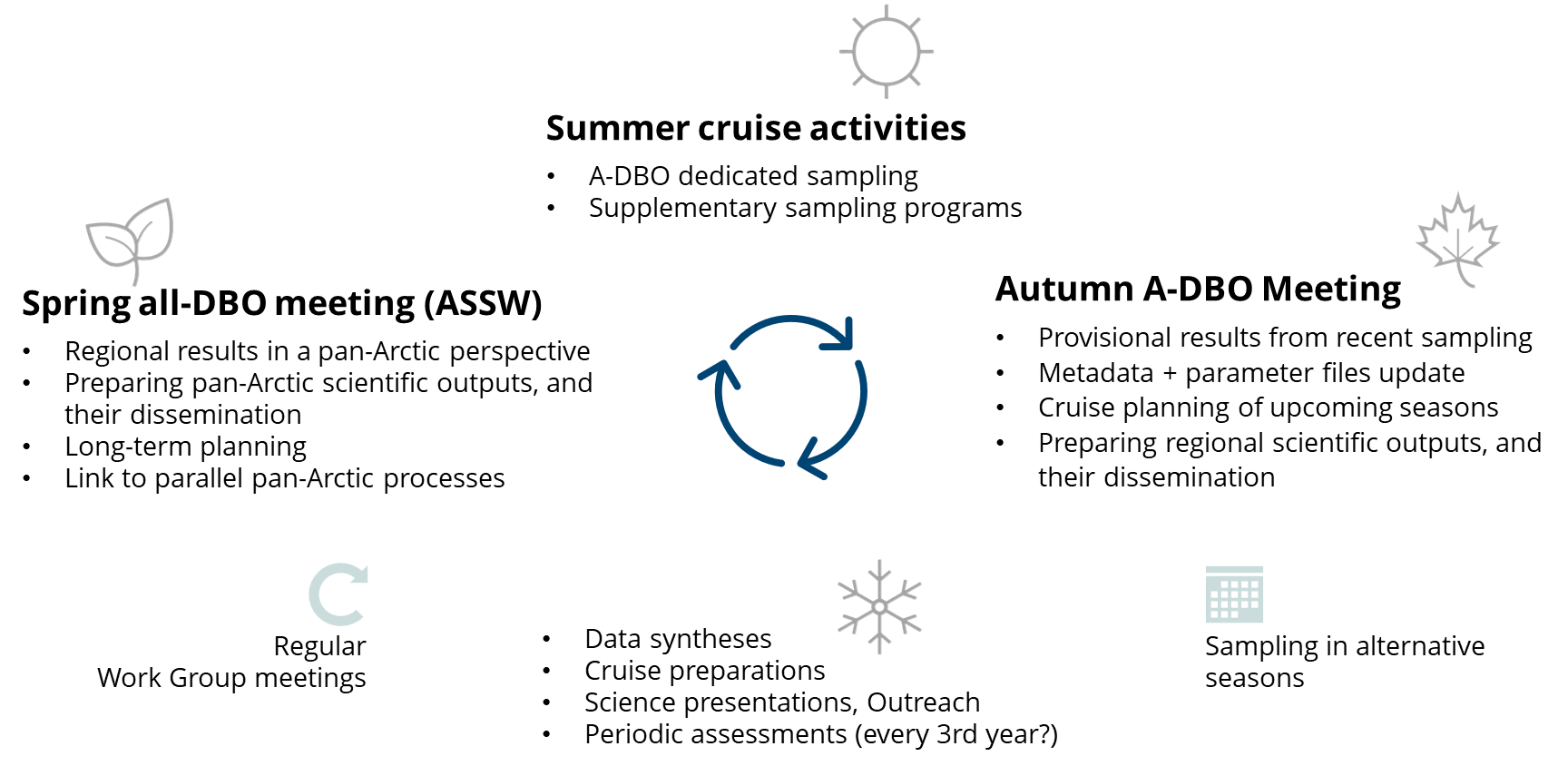
The DBO annual cycle. The regional community meetings take place in autumn,
while the main event for the pan-Arctic scope is the joint workshop at the annual Arctic Science Summit Week in spring.
FURTHER READING
- Poster at Arctic PASSION Symposium 2025: Towards a sustained pan-Arctic network of Distributed Biological Observatories (DBOs)
- Research Note in FRAM FORUM 2025: Connecting via the Atlantic–Arctic Distributed Biological Observatory
- Poster at Arctic Frontiers 2025: Developing the Pan-Arctic Network of Distributed Biological Observatories (DBOs)
- Key article on the DBO concept (2019): The Distributed Biological Observatory: A change detection array in the Pacific Arctic – An introduction
A-DBO PLANNING AND REPORTING TOOLS
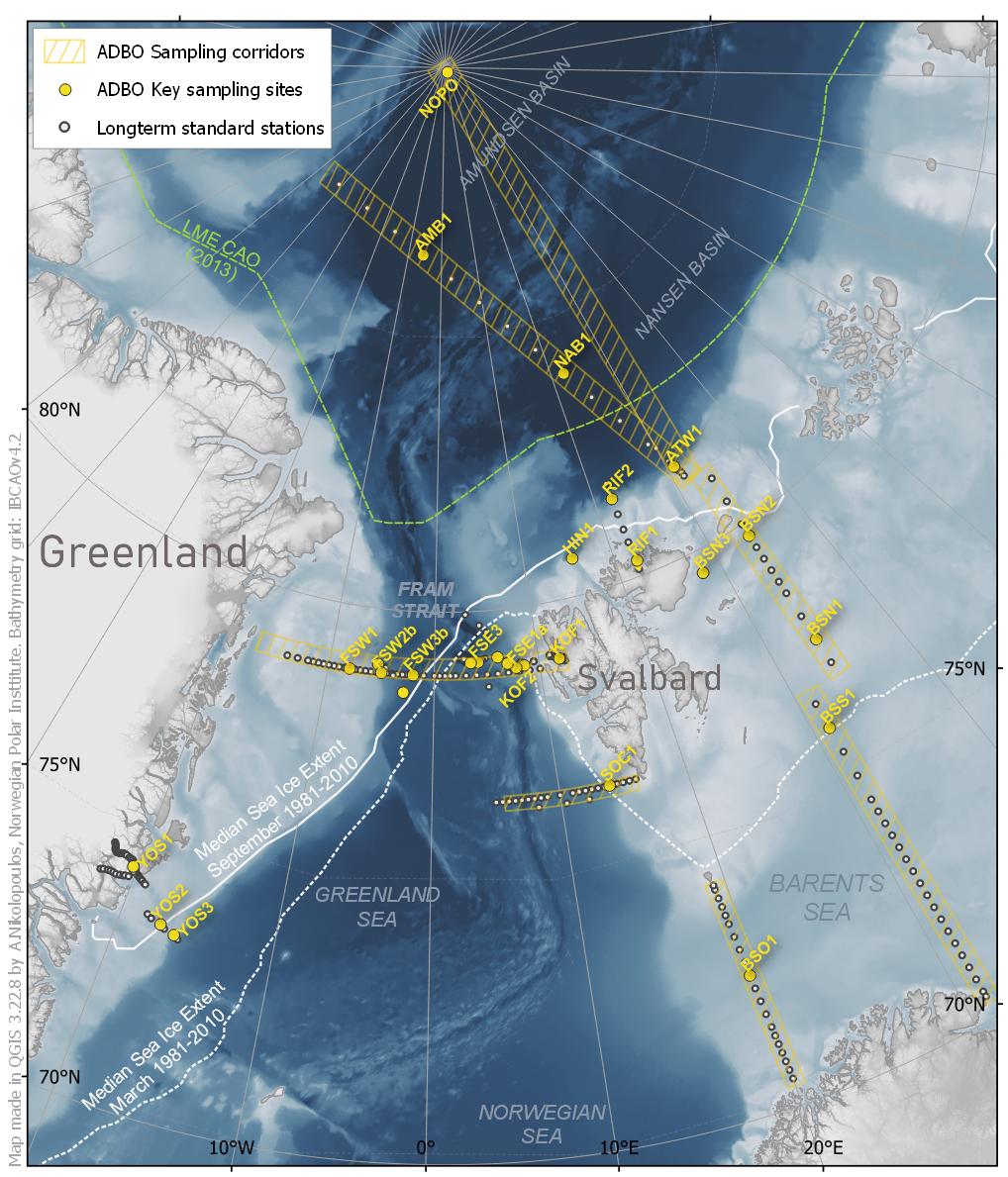
In our A-DBO Cruise Package you will find our current information on cruise plans for the region, the positions for the A-DBO key sampling sites and a template of the metadata file to be used for reporting back your observations.
The metadata sheet is established as our common living document on data availability to be shared rather swiftly after each field season. We welcome any parameters describing biological, chemical, or physical sea-ice, water-column or seabed properties (these can be selected from a given list, or added manually). Please note that the framework for collaborations extend geographically beyond the pronounced key sites, and is open to all actors within our region who identify an added value to or from our observational network. The metadata reports are currently sent to us, or brought to the A-DBO fall meetings. Please contact us for further information.
For improved comparability of data, and methodological agreement between various research groups, the A-DBO will work to formalize its best practices for sampling and analysis of our observations. For now, we warmly recommend the extensive collection of protocols by The Nansen Legacy project (https://doi.org/10.7557/nlrs.6684).
UPCOMING EVENTS
- A-DBO 2026 meeting
- 23-25 November 2026, Sopot, Poland (likely lunch-to-lunch)
Agenda to be developed
PAST ACTIVITIES
ASSW 2026 – 4th Community meeting for the pan-Arctic network of DBOs
- 28 March 2026, Aarhus, Denmark
The four DBO:s organized a joint, full-day DBO community meeting at ASSW2025, for overviews of the 2024 activities and for evolving common aims and initiatives ahead. For further info see the meeting description and agenda.
The four DBO:s organized a joint, full-day DBO community meeting at ASSW2025, for overviews of the 2024 activities and for evolving common aims and initiatives ahead. For further info see the meeting description and agenda.
A-DBO 2025 meeting
10–11 December 2025, Tromsø, Norway
- This year, our two-day program was filled to its rim by presentations on biological, chemical, physical marine observations (and some modelling!) within the Atlantic-Arctic sector with focus on activities in 2022-2025. We also got updates from related projects and programs, and shared plans onward to explore possible synergies. (see the meeting agenda).
- ASSW 2025 – 3rd Community meeting for the pan-Arctic network of DBOs
23 March 2025, Boulder, Colorado, USA
The four DBO:s organized a joint, full-day DBO community meeting at ASSW2025, for overviews of the 2024 activities and for evolving common aims and initiatives ahead. For further info see the meeting description and agenda. - A-DBO 2024 meeting
10 – 12 December 2024, Bremen, Germany
We were inspired of a long list of talks setting the 2024 perspectives for our Arctic sector, see the agenda. We also dedicated time to discuss what A-DBO is and is not, and how it should evolve onward: In what aspects do we wish, and are able, to harmonize our practices to strengthen our scientific outcomes? Both the scientific and organizational aspects conveyed through this meeting will be brought to the pan-Arctic scope, and our community meeting at ASSW2025. - ASSW 2024 – 2nd Community meeting for the pan-Arctic network of DBOs
21 March 2024, Edinburgh, Scotland, UK
Our second pan-Arctic DBO community meeting at ASSW2024, with presentations of the 2023 sampling activities and discussions about common aims and initiatives ahead, see the agenda. - A-DBO 2023 Autumn meeting
28 – 30 November 2023, Sopot, Poland
The main objective for this annual meeting was to give our members the opportunity to share experiences and outcomes of their 2023 activities and to summarize the observed status for the A-DBO sector. We also looked at the sampling plans for 2024 and discussed how to collectively strengthen our work onward – in terms of results, sampling plans, and common routines. As a tangible output from the meeting, we work on an overview of the 2023 conditions in the Fram Strait. This scope was agreed upon since several the harsh ice conditions north of Svalbard in early summer brought several cruises to this region, leading to a monthly coverage of some parameters between May and September. The overview was first presented at the all-DBO community meeting at ASSW2024 in Edinburgh, UK. For more information, see the agenda and meeting summary. - ASSW 2023 Joint DBO Sessions
17 – 24 February 2023, Vienna, Austria
The Pacific, Davis Strait and Atlantic DBOs jointly organized two sessions at the Arctic Science Summit Week 2023, in both the community and science parts of the conference: - A-DBO 2022 Autumn Meeting
31 October – 1 November 2022, Bergen, Norway
The first A-DBO dedicated meeting was held with focus on defining the fundamental spatio-temporal characteristics of the A-DBO and the associated core parameters to sample. We also took the opportunity to share news about our recent sampling activities and about our planned cruise activities. For more information, see the agenda and meeting minutes. - ASSW 2022 - Session on Establishing the Distributed Biological Observatory system in the Atlantic Sector of the Arctic Ocean
27 March 2022, Tromsø, Norway
In this workshop we initiated the process to implement a comprehensive marine observing system for climate and environment in the Atlantic sector of the Arctic Ocean. Inspired by the Pacific DBO system and based on existing long term observational programmes on the Atlantic side, discussions were initiated about priorities for sampling locations, variables, and methods as well as means of collaboration. A steering group was established to support the work of the executive team. For a summary of the workshop, see the meeting minutes. - Executive team: Arild Sundfjord (NPI), Marit Reigstad (UiT) and Jennifer Dannheim (AWI)
- Steering group: Angelika Renner (IMR), Agnieszka Beszczyńska-Möller (IOPAN), Joanne Hopkins (NOC), Michael Karcher (AWI), Mikael Sejr (AU), Monika Kedra (IOPAN), Laura de Steur (NPI), Claire Mahaffey (U Liverpool), and Tommaso Tesi (CNR)
- Email: AtlanticDBO[at]npolar.no